All life is changing the landscapes it inhabits, and humanity is no different. Look no further than dramatic examples of Yellowstone National Park, following the reintroduction of wolves (Hyperlink 1), or the any of countless landslides linked to land-use change. This anthropogenic landscape change, through Agriculture, Forestry and Other Land Use, currently contributes just under a quarter of society’s Greenhouse Gas emissions (Hyperlink 2). Changing human societies have also contributed historically to the large-scale storage of carbon. Reforestation following the migration of small-holding communities may have contributed to Europe’s “Little Ice Age” (CE ~1300-1850), featuring a drop in average temperatures (Hyperlink 3), alongside other positive impacts such as soil recovery and expanding populations of large carnivores (Hyperlink 4).
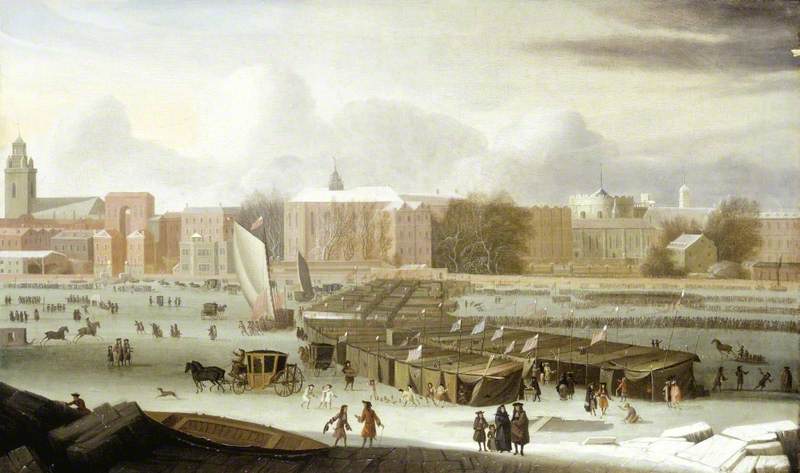
Hondius, Abraham; A Frost Fair on the Thames at Temple Stairs, London; Museum of London;
Available at: http://www.artuk.org/artworks/a-frost-fair-on-the-thames-at-temple-stairs-london-50550
Unlike the period preceding the “Little Ice Age”, with widespread plague and famine, Earth’s population is now growing, along with the demands we place upon our lands. We have never farmed more efficiently than we do now (Hyperlink 5), and there is growing recognition that we need to examine how we exploit our environment, to allow for the adaptation and mitigation of our climate crisis, alongside best meeting the needs of people globally.
Some may feel uncomfortable at my use of the word “exploit”, connecting with frustrations regarding how we have treated our land like a resource for so long, and like so many other resources, as disposable. I do in fact view our environment as a resource, but not as disposable. The services ecosystems and global processes provide support all life on earth, as well as our human economy, and this dependency will never end. Urgency is required in rebalancing how we utilise the land around us, whether for fallow or polyculture, many synergies exist between better meeting human needs and restoring our landscapes.
It is this urgency that drives us to question the values and stakeholders involved in with the landscape today. Were I allowed the soapbox of my dreams I would ask the public the following question:
What do we need from our landscape?
Food and beauty spring to mind. The aesthetics of the barren, pastural idyll are considered a hallmark of British beauty, and without a doubt preserved in the ruminant-grazed, semi-natural landscapes of Wales and the Peak District. Pasture does not however, provide the most diverse ecosystem services. Biodiversity is limited, and the land will not store carbon or regenerate soil like woodland (Hyperlink 6), nor provide the resilience to flooding and soil erosion that wetlands can (Hyperlink 7). We must ask what we value that the landscape provides beyond sustenance and identify opportunities to work with our desires.
The public now has its own soapbox, and is looking for its own answers:
How will we get what we need from the land?
Food is cheaper now in the developed world than it ever has been. The UK wastes more than a fifth of that food by weight outside of the farm gate (Hyperlink 8). Much of what we eat is cultivated in landscapes far removed from our own, and we are consuming the fertility of the soil, and the biodiversity of those landscapes as much as we are our own. Our interventions can provide both environmental and social benefits however, and a range of techniques exist, both historically, in development or in current use.
We will examine those techniques further later, but a crucial ingredient is still lacking: the measures of progress necessary to evaluate human interventions. These measures should not be forgotten when considering “what do we need from our landscape?”. Society should also play a role in determining not just the measures and methodologies the sciences use, but how these findings are best framed and communicated in the pursuit of social welfare. Care should be taken to consider the “is-ought” problem (Hyperlink 9), articulated by philosopher David Hume, where descriptions of how the world “is” should be held distinctive from statements prescribing how the world “ought” to be.
The points I have raised above deserve further attention, to be provided in due course, but I will leave this soapbox with this summary: We should treat our ecosystems the same way that we will treat our economies in encouraging mitigation and adaptation to climate change. Society should choose the measures of success accordingly, whether utilising indicator species, environmental net gain, or nutrient/carbon storage, alongside diverse social consideration. By viewing the study of ecosystems in parallel to other socioeconomic studies, we can develop the knowledge and techniques required to develop a sustainable path, and the social frameworks required to truly engage with our landscapes, and our impacts on them.
Hyperlinks and Further Information:
- https://www.yellowstonepark.com/things-to-do/wolf-reintroduction-changes-ecosystem
- https://www.ipcc.ch/site/assets/uploads/2018/02/ipcc_wg3_ar5_chapter11.pdf
- http://news.bbc.co.uk/1/hi/sci/tech/4755328.stm
- https://books.google.co.uk/books?id=-K7kCwAAQBAJ&pg=PA147&lpg=PA147&dq=black+death+%22fallow%22&source=bl&ots=ijnnqMaQRK&sig=ACfU3U36Bgv9EGCaNpFlvU6cng_1IvE3mw&hl=en&sa=X&ved=2ahUKEwjmlPCl-5znAhVYPcAKHcFtBdoQ6AEwF3oECAkQAQ#v=onepage&q=black%20death%20%22fallow%22&f=false
- https://ourworldindata.org/crop-yields
- https://pdfs.semanticscholar.org/0e04/94d27d7c094312283566f35aea835459e467.pdf
- https://www.epa.gov/wetlands/why-are-wetlands-important
- https://wrap.org.uk/sites/files/wrap/Food_%20surplus_and_waste_in_the_UK_key_facts_Jan_2020.pdf
- https://en.wikipedia.org/wiki/Is%E2%80%93ought_problem#Implications
Figure 1: A Frost Fair on the Thames at Temple Stairs, London 1684, Abraham Hondius (c.1625–1691), Museum of London.
 Tales of Precaution and Positivity