Featured

The arguments of Hobbes and Boyle: The example of Aristotle and the four-legged mayfly

Callibaetis ferrugineus hageni (Source: Harvey Schmidt, 2011)

“[…] the dayfly (ephémeron) moves with four feet and four wings; […] exceptional not only in regard to the duration of its existence, whence it receives its name, a quadruped it has wings also.

— Aristotle (the famous one!), History of Animals 490a–b.

Sometimes it is hardest to objectively consider the topics that are closest to the heart, or that may impact your life significantly and personally. Here we will look at a case that is likely neither of those, for most readers: the case of Aristotle and the four-legged fly.

Apologies to any entomologists….

Many argue science’s core tenet is skepticism, but Steven Shapin counters that science is more reliant on trust and diligence than most other social systems (Hyperlink 1); many scientists may question the freshness of the milk on their doorstep more so than the chemicals in their lab.

Collective knowledge is a social construction requiring curation, and is ever shifting (see half-life of knowledge, Hyperlink 2), yet this blog will cover the controversy of the mayfly’s legs, and reveal how for hundreds of years an “untruth” persisted.

Below is a diagram showing two possible routes to the “truth” of the mayfly’s legs; firstly, Boyle’s preferred empirical approach (stating that rationally acceptable beliefs are only justifiable or knowable through experience), secondly, a traditional academic approach (where knowledge imparts from a culturally-derived source).
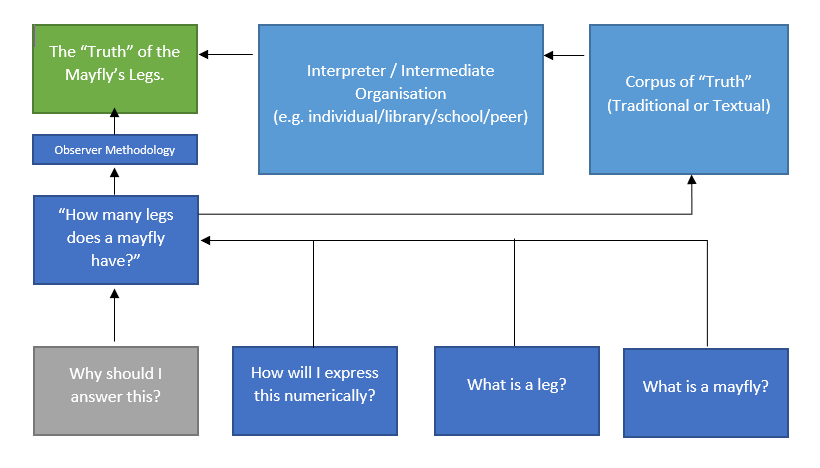
The Author’s graph demonstrating the academic route (light blue) and the empirical route (blue) to the “Truth” of the mayfly’s legs.

Considering the elements, it is clear that in the case of the academic route that the Corpus referred to has been constructed socially, and belongs to institutions who curate and/or interpret the texts or traditions. A strident empiricist may argue that the observer’s methodology determines the quality of the truth, and that where the proper methodology yields replicable results, a “pure” truth has been revealed, unsullied by social influence.

Looking at the lowest layer of this graph, we see how the question itself is composed of semantic elements (dark blue), difficult to unpick from social influence; and an element of significance that motivates the interested party in carrying out an investigation.

Simply, Aristotle stated mayfly’s have four legs, a “truth” that would very much be disputed today, yet was apparently repeated in natural history texts for thousands of years, often extrapolated to a statement about all flies (Hyperlink 3) (Aristotle did in fact distinguish insects). As Aristotle did not use a distinct numerical system, and was by all accounts an astute observer, we should consider where the lack of consensus arises, and whether the correct questions were asked:

“What is a leg?”:

Aristotle counted and communicated “leggedness” based on functionality, particularly utilisation of limbs for walking/locomotion. The forelegs of many adult mayfly are specialised for mating (the sole task of an adult mayfly), and thus were not counted (Hyperlink 4). Scientific consensus, and possibly even society, does not use the same functional definition of legs as Aristotle, and these socially-constructed semantics are arrived at by deliberation and communicated in socially-defined languages, and thus are not universal across time and space.

“What is a mayfly?”:

Aristotle refers to “ephémeron“, of which 2000+ species are now recognised, and often referred to mayflies as “the shortest-lived animal”, “emerging from sacks” (Hyperlink 5). This belies the fact that Aristotle had not recognised the juvenile state of the mayfly, lasting up to two years, in which the role of the forelegs is unrelated to reproduction, but is utilised for locomotion: a “leg” by Aristotle’s own definition.

Concluding

…despite mayflies existing in their many-legged states as a matter of fact, we can see how each different socially-determined formulation of the proposition lead to divergence in the “truth” of the matter. Aristotle’s answer is no less valid to his peers than our’s is now, regardless, it is of little significance to most at any period in time. Perhaps this is exactly why the “mistruth” persisted with such little opposition for so long, and was so readily accepted.

Hobbes would agree, arguing that where knowledge is considered significant, publics resist inculcation, and should rationalise their own formulation of the question, and produce their mayfly knowledge collectively, with all the nuance that may bring.

Boyle would probably argue Aristotle’s methodology was flawed and suffocate the poor animal with his air pump just to check…

Hyperlinks:

  1. https://www.cbc.ca/radio/ideas/how-to-think-about-science-part-16-1.464997
  2. https://en.wikipedia.org/wiki/Half-life_of_knowledge
  3. https://www.ncbi.nlm.nih.gov/pmc/articles/PMC1299297/
  4. https://scienceblogs.com/evolvingthoughts/2008/09/16/aristotle-on-the-mayfly
  5. https://books.google.co.uk/books?id=CU4gBQAAQBAJ&pg=PA260&lpg=PA260&dq=aristotle+shortest+lived+animal+mayfly&source=bl&ots=XASzRJ9k2L&sig=ACfU3U1Lct_jMnlYZ03DvQxYAOAE39FFhA&hl=en&sa=X&ved=2ahUKEwjQ9NeFuZfnAhUMGsAKHQXTA8wQ6AEwC3oECAsQAQ#v=onepage&q=aristotle%20shortest%20lived%20animal%20mayfly&f=false
A Soapbox and a Landscape #2

The Who and the How

In preparatory discussions for these blogs, fellow writer and activist Meg Watts forwarded me an insightful passage from ‘An interview with Benjamin Myers’, in the counterculture zine ‘Weird Walk’:

“’Wild’, [my neighbour] told me, wasn’t a useful term. He pointed to a small cluster of trees a half-mile away: ‘Left to its own devices, all this land wants to be that. And that isn’t exactly right anymore.’“

Weird Walk; Issue 2; p23(Hyperlink 1)

Occurring in “Constable Country”, in Suffolk, so named after the bucolic painter John Constable, this pastoral perspective is uniquely Western. Alongside losing our landscape’s natural capital, we may have lost other diverse normative perspectives of how our landscapes “ought” to be. The dominance of enclosed agriculture, and its idyll, is pervasive. We must consider the power dynamics that propagated these normative perspectives and discern who and how will we answer the question: “What do we need from our landscape?”.

A traditional, “linear perspective”, sets knowledge makers as distinct from the general public, in order to generate and codify “truths” to be distributed from the top down. This has been the case for most of human history, where religious figures or knowledge-holders may discern their “truths” from the environment or texts, and the sciences have been treated no differently for most of their duration. Separating social influence was as fundamental to the communication of the Ten Commandments as the establishment of Boyle’s Law.

At the opposite end of the spectrum, where science and society “make things together”, lie the “co-productionist” perspectives. Often framed in terms of obtaining more relevant knowledge, that is more representative of the experiences of the public at large, “Common Sense” co-production brings society into the sciences without changing the positions of institutions like the Royal Society as “knowledge makers”.

Sheila Jasanoff presents an alternative alternative, her co-production focusing instead on society’s role in describing, analysing and interpreting in order to co-produce knowledge. Much attention is devoted to systems that better represent the complexity of knowledge, regarding public perceptions of how the world “is”, and how it “ought” to be, not in the pursuit of a singular robust result, but rather multifaceted solutions with many shades of “rightness”, and a process that is itself flexible and inclusive. Novel approaches to considering who answers the questions the public pose have never been more necessary than now.

As for the how to answer our question… consensus is only one of many group decision-making techniques, and many support the novel approach known as “post-normal science”, applied where “facts [are] uncertain, values in dispute, stakes high and decisions urgent” (Funtowicz, S. and Ravetz, J., 1993. “Science for the post-normal age”, Futures, 31(7): 735-755.). Relevant, amongst our ongoing environmental crises, this post-normal approach disputes more of the process of science, focusing as much on “who gets funded, who evaluates quality, who has the ear of policy – as on the facts of science” (Hulme, 2007; Hyperlink 2)

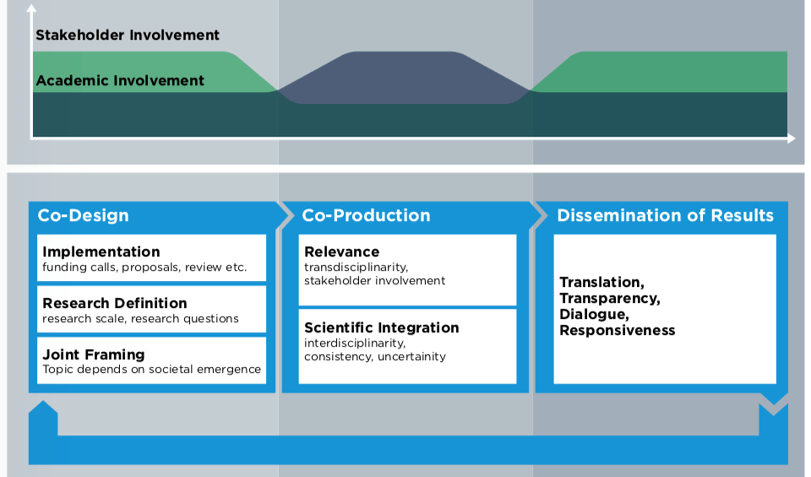
Figure 1: Future Earth’s “Steps and involvement in co-design and co-production of scientific knowledge”
Available at: http://old.futureearth.org/sites/default/files/Future-Earth-Design-Report_web.pdf

Both post-normal and co-productionist approaches are identifiable in research programmes such as “Future Earth”, which hosts research topics ranging from agriculturally-initiated migration (Hyperlink 3), to modelling future land cover change (Hyperlink 4). The advantages were best described by Prof. Hans Hurni:

“Studies on land degradation were first done mainly by bio-physical sciences […] The roles of land users were addressed only at a later stage when it became clear that the problems needed to be addressed by them. [transitioning] to transdisciplinary approaches, where groups of scientists would work with local land users and concerned stakeholders and include their knowledge systems in finding appropriate solutions”

Prof. Hans Hurni. Interview available at: https://futureearth.org/2015/10/08/qa-with-hans-hurni/

How far we have travelled away from our cosy physical science lairs… The alternative local knowledge systems Hurni described are often holistic worldviews derived from multiple generation’s engagement with the same landscape. Many describe the direct connections that exist between human lifestyle and the land. Though these visceral relationships are integrated in Traditional Ecological Knowledge (TEK), these perspectives were considered revolutionary when introduced by scholars such as Jasanoff, as the following quotes illustrate:

‘‘the ways in which we know and represent the world (both nature and society) are inseparable from the ways in which we choose to live in it’’

Jasanoff (2004) (Hyperlink 5)

“The major difference between Indigenous and non-Indigenous conceptions of TEK is that Indigenous people see TEK as much more than a ‘body of knowledge’; rather, it is a ‘way of living’, it is about how one relates to Mother Earth”

MacGregor (2018) (Hyperlink 6)

It is clear we need to address the ways that we produce knowledge and live amongst our landscapes. The increasing diversity of approaches, as discussed above, offers hope. Our current opportunity to democratise sociotechnical structures is unprecedented, but power imbalances persist. Many communities holding TEK or excluded from the scientific narrative will be amongst the worst affected by climate change. It is these voices we need to listen to and consider in order to properly ask “What do we need from our landscape?”.

Hyperlinks:

  1. https://www.outsidersstore.com/weird-walk-zine-issue-2-189162 (p.23)
  2. https://www.theguardian.com/society/2007/mar/14/scienceofclimatechange.climatechange
  3. http://old.futureearth.org/blog/2019-apr-26/when-land-needed-people-are-not
  4. http://old.futureearth.org/blog/2019-apr-26/uncertainties-future-global-land-use-and-land-cover-change
  5. https://www.taylorfrancis.com/books/e/9780203413845
  6. https://www.routledge.com/Companion-to-Environmental-Studies-1st-Edition/Castree-Hulme-Proctor/p/book/9781138192201 (p.704)

A Soapbox and a Landscape

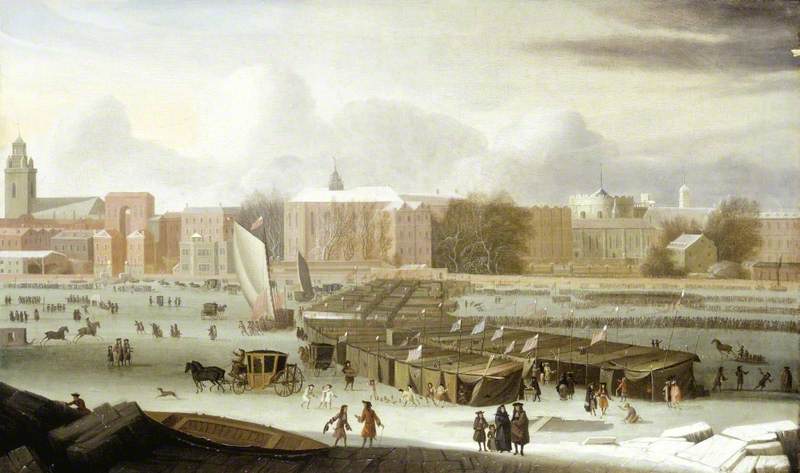
All life is changing the landscapes it inhabits, and humanity is no different. Look no further than dramatic examples of Yellowstone National Park, following the reintroduction of wolves (Hyperlink 1), or the any of countless landslides linked to land-use change. This anthropogenic landscape change, through Agriculture, Forestry and Other Land Use, currently contributes just under a quarter of society’s Greenhouse Gas emissions (Hyperlink 2). Changing human societies have also contributed historically to the large-scale storage of carbon. Reforestation following the migration of small-holding communities may have contributed to Europe’s “Little Ice Age” (CE ~1300-1850), featuring a drop in average temperatures (Hyperlink 3), alongside other positive impacts such as soil recovery and expanding populations of large carnivores (Hyperlink 4).

Figure 1: A painting of market stalls on the frozen Thames c.1625–1691.
Hondius, Abraham; A Frost Fair on the Thames at Temple Stairs, London; Museum of London;
Available at: http://www.artuk.org/artworks/a-frost-fair-on-the-thames-at-temple-stairs-london-50550

Unlike the period preceding the “Little Ice Age”, with widespread plague and famine, Earth’s population is now growing, along with the demands we place upon our lands. We have never farmed more efficiently than we do now (Hyperlink 5), and there is growing recognition that we need to examine how we exploit our environment, to allow for the adaptation and mitigation of our climate crisis, alongside best meeting the needs of people globally.

Some may feel uncomfortable at my use of the word “exploit”, connecting with frustrations regarding how we have treated our land like a resource for so long, and like so many other resources, as disposable. I do in fact view our environment as a resource, but not as disposable. The services ecosystems and global processes provide support all life on earth, as well as our human economy, and this dependency will never end. Urgency is required in rebalancing how we utilise the land around us, whether for fallow or polyculture, many synergies exist between better meeting human needs and restoring our landscapes.

It is this urgency that drives us to question the values and stakeholders involved in with the landscape today. Were I allowed the soapbox of my dreams I would ask the public the following question:

What do we need from our landscape?

Food and beauty spring to mind. The aesthetics of the barren, pastural idyll are considered a hallmark of British beauty, and without a doubt preserved in the ruminant-grazed, semi-natural landscapes of Wales and the Peak District. Pasture does not however, provide the most diverse ecosystem services. Biodiversity is limited, and the land will not store carbon or regenerate soil like woodland (Hyperlink 6), nor provide the resilience to flooding and soil erosion that wetlands can (Hyperlink 7). We must ask what we value that the landscape provides beyond sustenance and identify opportunities to work with our desires.

The public now has its own soapbox, and is looking for its own answers:

How will we get what we need from the land?

Food is cheaper now in the developed world than it ever has been. The UK wastes more than a fifth of that food by weight outside of the farm gate (Hyperlink 8). Much of what we eat is cultivated in landscapes far removed from our own, and we are consuming the fertility of the soil, and the biodiversity of those landscapes as much as we are our own. Our interventions can provide both environmental and social benefits however, and a range of techniques exist, both historically, in development or in current use.

We will examine those techniques further later, but a crucial ingredient is still lacking: the measures of progress necessary to evaluate human interventions.  These measures should not be forgotten when considering “what do we need from our landscape?”. Society should also play a role in determining not just the measures and methodologies the sciences use, but how these findings are best framed and communicated in the pursuit of social welfare. Care should be taken to consider the “is-ought” problem (Hyperlink 9), articulated by philosopher David Hume, where descriptions of how the world “is”  should be held distinctive from statements prescribing how the world “ought” to be.

The points I have raised above deserve further attention, to be provided in due course, but I will leave this soapbox with this summary: We should treat our ecosystems the same way that we will treat our economies in encouraging mitigation and adaptation to climate change. Society should choose the measures of success accordingly, whether utilising indicator species, environmental net gain, or nutrient/carbon storage, alongside diverse social consideration. By viewing the study of ecosystems in parallel to other socioeconomic studies, we can develop the knowledge and techniques required to develop a sustainable path, and the social frameworks required to truly engage with our landscapes, and our impacts on them.

Hyperlinks and Further Information:

  1. https://www.yellowstonepark.com/things-to-do/wolf-reintroduction-changes-ecosystem
  2. https://www.ipcc.ch/site/assets/uploads/2018/02/ipcc_wg3_ar5_chapter11.pdf
  3. http://news.bbc.co.uk/1/hi/sci/tech/4755328.stm
  4. https://books.google.co.uk/books?id=-K7kCwAAQBAJ&pg=PA147&lpg=PA147&dq=black+death+%22fallow%22&source=bl&ots=ijnnqMaQRK&sig=ACfU3U36Bgv9EGCaNpFlvU6cng_1IvE3mw&hl=en&sa=X&ved=2ahUKEwjmlPCl-5znAhVYPcAKHcFtBdoQ6AEwF3oECAkQAQ#v=onepage&q=black%20death%20%22fallow%22&f=false
  5. https://ourworldindata.org/crop-yields
  6. https://pdfs.semanticscholar.org/0e04/94d27d7c094312283566f35aea835459e467.pdf
  7. https://www.epa.gov/wetlands/why-are-wetlands-important
  8. https://wrap.org.uk/sites/files/wrap/Food_%20surplus_and_waste_in_the_UK_key_facts_Jan_2020.pdf
  9. https://en.wikipedia.org/wiki/Is%E2%80%93ought_problem#Implications

Figure 1: A Frost Fair on the Thames at Temple Stairs, London 1684, Abraham Hondius (c.1625–1691), Museum of London.

Asimov and the Integrated Narrative

The First Law: A robot may not injure a human being or, through inaction, allow a human being to come to harm.

The Second Law: A robot must obey the orders given it by human beings except where such orders would conflict with the First Law.

The Third Law: A robot must protect its own existence as long as such protection does not conflict with the First or Second Laws.

Isaac Asimov’s ‘Three Laws of Robotics’, introduced in 1942’s “Runaround” (Hyperlink 1):

Reading Asimov, it is clear the discourse between the literary and scientific disciplines is thick with tradition…

… for instance, founding empiricists such as Robert Boyle utilised literary techniques to develop and engage the public’s role as “virtual witnesses” (Hyperlink 2) whilst demonstrating the character of the author as modest and reliable. Samsung exemplified the “prior art” defence arguing that Stanley Kubrick (assisted by science fiction novelist Arthur C. Clarke) invented the personal tablet computer, not Apple (Hyperlink 3).  Scientific models and communication have also been integrated into elements of the New Formalist literary movement, reinterpreting the styles, diagrams and metaphors of the scientific form to aid with the communication of abstract themes (Hyperlink 4). Techniques and forms flow between the disciplines, and many fundamental communicative challenges are shared.

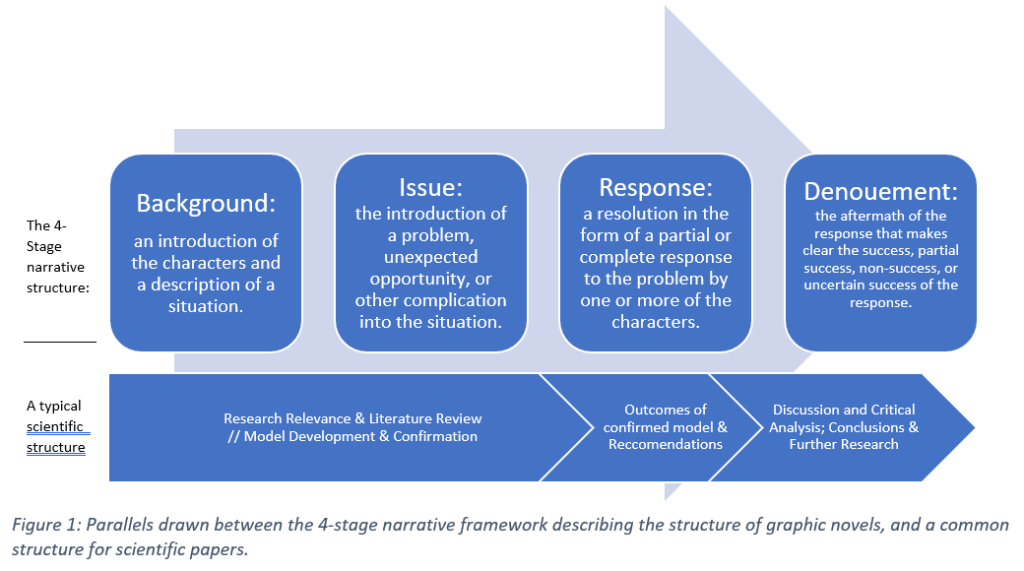
Introducing the 4-stage narrative framework (common within graphic novels) to scientific forms requires no adaptation (Figure 1):

This structure addresses some relevant traits shared by scientific literature and graphic novels/comic books: a requirement for clear, concise texts; developed, but sometimes competing bodies of knowledge (the literary canon); and the frequent addition of alien “undiscovered” concepts. Above, we see both structures start by communicating the shared set of assumptions and models that ground the narrative. Figure 1 shows both structures end not with the response and resolution, but by acknowledging the interplay between the reader’s existing bodies of knowledge and the bodies of knowledge created or modified within the narrative.

Both the scientific and the 4-stage narrative structures recognise that individual works often contribute just a fragment to the arcs of comic book canons, or to our scientific knowledge. However, this iterative, compartmentalised approach to granularity allows for the dynamic exploration of new concepts whilst addressing their resultant uncertainties.

Unsurprisingly then, narrative concepts already exist within the scientific framework, in the form of the “Sociotechnical Imaginaries”, described as:

“[C]ollectively imagined forms of social life and social order reflected in the design and fulfillment of nation-specific scientific and/or technological projects”.

Jasanoff & Kim, 2009 (Hyperlink 5)

I would like challenge this formulation. Here the role of the narrative is strictly to assist in informing the design of these projects, and to motivate the design’s fulfillment. Little attention is given to the competing normative perspectives that can occur in creating these visions, or in reacting to projects as they are constructed. Nor is there adequate focus on the underlying power dynamics influencing which narratives emerge as “collectively imagined”.

What of the need to critique pathways and projects that are already underway?

The “sociotechnical imaginaries” are often limited to positive visions, rather than the interrogatory narratives imbued into works like Rachel Carson’s ‘Silent Spring’ or Isaac Asimov’s ‘Three Laws of Robotics’. By limiting the concept only to emergent narratives, the “sociotechnical imaginary” excludes both the narratives derived from current lived experience, and the dynamism of large-scale, shifting social narratives. I would argue for the evolution of the “sociotechnical imaginary” concept within the co-productionist perspective; to better integrate Jasanoff’s emphasis of reflexive analysis and interpretation within co-production; and acknowledge competition between sociotechnical narratives.

As always, I defer to Asimov. In the spirit of dynamism, he added the fourth, or ‘Zeroth Law’ of robotics:

A robot may not harm humanity, or, by inaction, allow humanity to come to harm.

Foundation and Earth (1986, Hyperlink 6)

In case more Asimov-based arguments were needed for considering subjectivity and diversity in the creation of  collective knowledge and narratives…

The Zeroth Law was first incorporated into Asimov’s novels not by Asimov, but by French translator Jacques Brécard:

“A robot may not harm a human being, unless he finds a way to prove that ultimately the harm done would benefit humanity in general!”

Jacques Brécard, reinterpreting character Elijah Baley’s dialogue in his translation of Asimov’s “The Caves of Steel” (Hyperlink 7)

Later stated explicitly, this ‘Zeroth Law’ allowed Asimov to deal with abstraction and epistemological uncertainty, much like the techniques of Thomas Hobbes and the New Formalists, and like Jasanoff’s vision of pluranimous co-production, it was used to critique the need for consensus. I will leave you once again, with messy questions regarding the true place of narratives in the sciences, and the timeless words of Asimov:

Trevize frowned. “How do you decide what is injurious, or not injurious, to humanity as a whole?”

“Precisely, sir,” said Daneel. “In theory, the Zeroth Law was the answer to our problems. In practice, we could never decide. A human being is a concrete object. Injury to a person can be estimated and judged. Humanity is an abstraction.”

Foundation and Earth (1986, Hyperlink 6)

Hyperlinks and Further Reading:

  1. https://en.wikipedia.org/wiki/Three_Laws_of_Robotics
  2. https://royalsocietypublishing.org/doi/10.1098/rsnr.2018.0051
  3. https://www.cnet.com/news/samsung-says-2001-a-space-odyssey-invented-the-tablet-not-apple/
  4. https://muse.jhu.edu/article/734309/pdf
  5. https://www.researchgate.net/publication/227303577_Containing_the_Atom_Sociotechnical_Imaginaries_and_Nuclear_Power_in_the_United_States_and_South_Korea
  6. https://openlibrary.org/works/OL46347W/Foundation_and_Earth
  7. Asimov, Isaac (1952). The Caves of Steel. Doubleday., translated by Jacques Brécard as Les Cavernes d’acier. J’ai Lu Science-fiction. 1975. ISBN 978-2-290-31902-4. Available via Hyperlink: https://www.books-by-isbn.com/authors/isaac/asimov/

    An introduction to Co-Production: https://journals.plos.org/plosbiology/article?id=10.1371/journal.pbio.2001403

    For Jasanoff and Kim’s updated work:
    https://press.uchicago.edu/ucp/books/book/chicago/D/bo20836025.html

The Author

My name is Connor Enright, and here are a few things you should know about me:

  • I have always wanted to be a scientist, first a naturalist, then a physicist, and now a generalist.
  • I study Natural Sciences, an interdisciplinary science subject at UEA, and have transistioned from a physical chemistry background to look more at problems involving people.
  • I can find social science incredibly challenging, and it is these challenges that have helped me evaluate and improve my ideas and thinking over the last several years.
  • I am a creative writer, and believe that science communication should go beyond posters and demos, and that creative, emotive and narrative writing all have a part to play in effective communication and engagement.

This blog will attempt to resolve some of the issues emerging from our current scientific practices, institutions, and their relation with our socioeconomic systems.

Design a site like this with WordPress.com
Get started